More Heat than Life: The Tangled Roots of Ecology, Energy, and Economics by Jeremy Walker
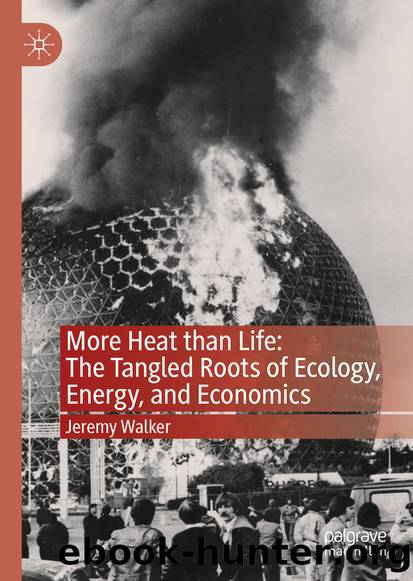
Author:Jeremy Walker
Language: eng
Format: epub
ISBN: 9789811539367
Publisher: Springer Singapore
The Invisible Vernadskyan Revolution
As Newsweek declared the ‘age of ecology’ in 1970, an existential moment had arrived in the Western cosmopolitical imagination. For the first time, ecologists were offered an opportunity to communicate their science through the mass media to a wide audience, one that had benefitted from the increased opportunities for higher education of the post-war welfare state. Thus the term ‘ecology’ entered into common parlance for the first time. With it came arguably the first generation to develop an ecological consciousness of the Earth as whole, a movement of thought that would be concentrated in the form of the world-revealing photographs of the Earth in a single frame, beamed back to her from afar by the spacecraft of the Apollo programme. Perhaps nothing brought home ‘the simple fact that the Earth is finite’ more than the picture of a solitary blue orb, suspended alone in the vast reaches of outer space, perhaps the only home for life in the Universe.
The grandest aim of environmentalism in the 1970s, it might be said, was to establish an ‘age of ecology’ which would correct the apocalypse-blindness of the ‘age of economics’ and allow us to restore and maintain the ‘balance of nature’. But which ecology, and which concept of balance, equilibrium, or harmony? A passing acquaintance with the history of ecology reveals that, like other branches of knowledge that address complex totalities, it has never achieved anything like an internal consensus as regards its paradigmatic methods and models, and its borders with other branches of science are often porous.
The first scientist to fully recognise solar-driven photosynthesis and biological life’s evolutionary trajectory as the profoundest force in the transformation of the Earth’s inanimate geochemistry was the brilliant Russian mineralogist, pedologist, and biochemist Vladimir Vernadsky (1863–1945). Developing the concept of ‘the biosphere’—a term proposed fifty years earlier by Edward Suess—Vernadsky first presented empirical demonstrations of his thesis in La Geochimie (1924), a work published in French which contained the first use of the term ‘the carbon cycle’.8 This was followed by his great work, the visionary systematic synthesis of Biosfera (1926), published first in his native Russian, and in French translation in 1929.9 These works superseded an older presumption of evolutionary history, that life had evolved on Earth within the thermal and geochemical limits imposed by a relatively stable lithosphere, hydrosphere, and atmosphere.
As Jacques Grinevald argues, it is one of the great tragedies of intellectual history that Vernadsky’s revolutionary scientific paradigm remained long confined behind the iron curtains of Cold War geopolitics.10 Vernadsky was almost entirely unknown in the West until references to his work began to appear in English, following an epoch-making article in Scientific American on ‘The Biosphere’ (1970) by G.E. Hutchinson.11 Intellectual traffic between Western scientists and those of the Soviet Union—where Vernadsky’s standing as the originator of biosphere theory had long been honoured—increased through international environmental science collaborations in the mid- to late 1970s, especially via the climatologist Mikhail Budyko’s early work on global warming and the climatic aspects of the ‘evolution of the biosphere’.
Download
This site does not store any files on its server. We only index and link to content provided by other sites. Please contact the content providers to delete copyright contents if any and email us, we'll remove relevant links or contents immediately.
International Integration of the Brazilian Economy by Elias C. Grivoyannis(111322)
The Radium Girls by Kate Moore(12096)
Turbulence by E. J. Noyes(8123)
Nudge - Improving Decisions about Health, Wealth, and Happiness by Thaler Sunstein(7762)
The Black Swan by Nassim Nicholas Taleb(7200)
Rich Dad Poor Dad by Robert T. Kiyosaki(6728)
Pioneering Portfolio Management by David F. Swensen(6342)
Man-made Catastrophes and Risk Information Concealment by Dmitry Chernov & Didier Sornette(6142)
Zero to One by Peter Thiel(5874)
Secrecy World by Jake Bernstein(4804)
Millionaire: The Philanderer, Gambler, and Duelist Who Invented Modern Finance by Janet Gleeson(4539)
The Age of Surveillance Capitalism by Shoshana Zuboff(4355)
Skin in the Game by Nassim Nicholas Taleb(4310)
The Money Culture by Michael Lewis(4268)
Bullshit Jobs by David Graeber(4252)
Skin in the Game: Hidden Asymmetries in Daily Life by Nassim Nicholas Taleb(4052)
The Dhandho Investor by Mohnish Pabrai(3826)
The Wisdom of Finance by Mihir Desai(3793)
Blockchain Basics by Daniel Drescher(3641)
